
Have you ever attended a wedding with delicious food? And couldn’t stop talking about the mashed potatoes on your drive home that night? Same. (My sister-in-law’s vegan menu was like a homemade Thanksgiving dinner.)
A good meal elevates the experience of being a guest. A bad meal, on the other hand, leaves guests hungry and grumpy. Not ideal.
Let’s face it: catering is the cornerstone of your reception.
But it can be tricky to select a menu that 1) Appeals to a variety of tastes 2) Accommodates dietary needs and 3) Fits within your budget.
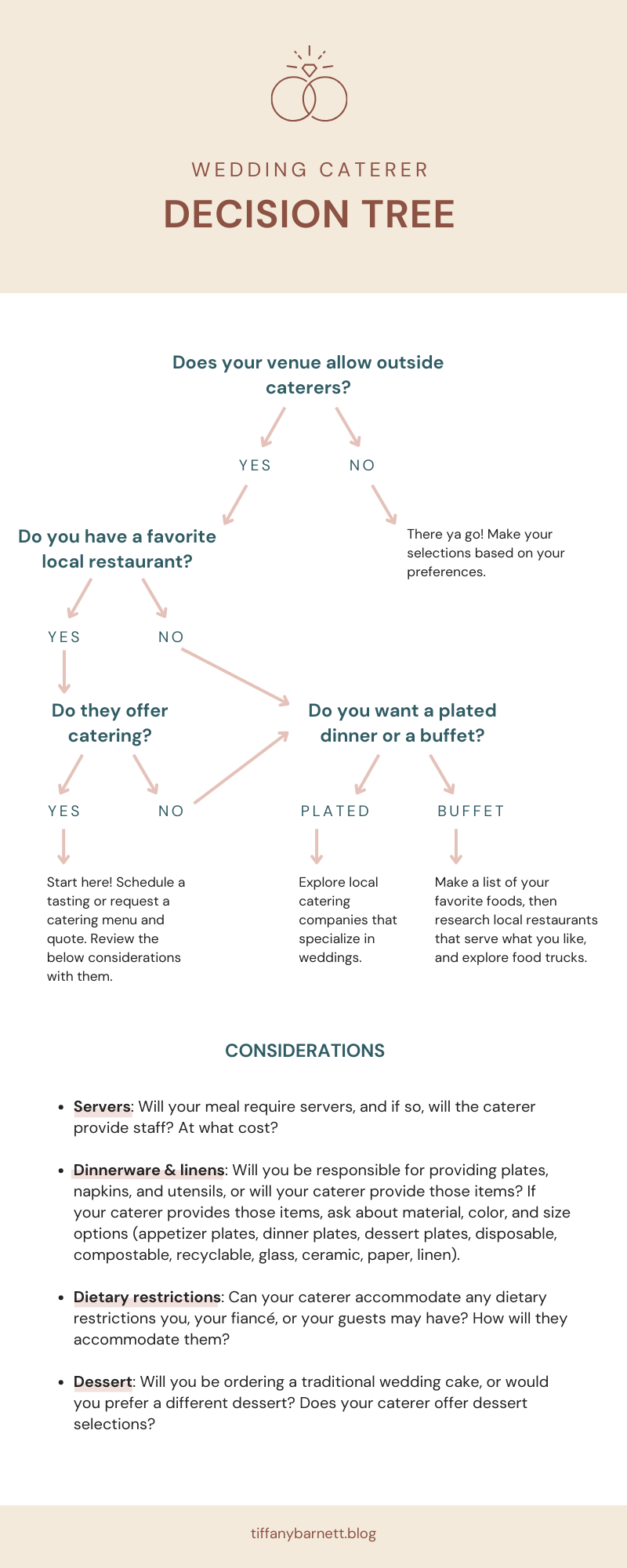
Below is a decision tree to help you narrow down your choices, as well as things to consider when booking your caterer.
Your venue’s policies
Part of the reason I recommend booking your venue first when you begin planning your wedding is because your venue’s accommodations and policies will influence your other vendor decisions.
Venues fall into one of three catering categories:
- In-house: You must use the venue’s in-house caterer.
- Preferred vendors: You must select from a short list of preferred caterers the venue has worked with in the past.
- Bring your own: You can use any caterer (usually requiring some kind of venue approval).
Start by figuring out what your venue’s catering policy is.
If your venue has an in-house caterer, you’ll work with them to create your menu, and you may or may not have a choice between a plated dinner (served to each guest individually based on their pre-selected meals) and a buffet.
If your venue has a short list of preferred caterers, you’ll choose the one you like best. Again, they may or may not offer a choice between a plated dinner and a buffet.
And if your venue welcomes all caterers, you’ll have the freedom to select the food you want and how it’s served. You could even book multiple vendors depending on your tastes and budget!
Plated vs. buffet
As mentioned above, a plated dinner is served restaurant-style to each guest individually based on their pre-selected meals. While a plated dinner is more formal, it requires collecting guests’ meal choices prior to your wedding, which can add a layer of stress to your planning. Here’s why: you’ll have to confirm the number of each meal with your caterer in advance so that they know how much to cook, and you’ll have to coordinate your guest’s meal selections with your seating chart. If you have last-minute RSVPs (and you most likely will), there’s a chance you could be fine-tuning your catering order until the day of your wedding.
A buffet dinner features all your menu items, and guests either serve themselves, or servers stationed behind the buffet serve your guests as they come through the line. The main pro of a buffet is that it requires less advance planning because guests can select the items they want and bypass the ones they don’t. The downside of a buffet is that someone needs to coordinate releasing each table to visit the buffet in order to avoid a long line, so guests have to wait their turn.
If your venue allows the option, and you have a strong preference toward either a plated dinner or a buffet, start your catering search based on that preference.
Prep space
Think through the layout of your venue, including indoor and outdoor space available for use.
Indoor
Before hiring a caterer, you’ll need to know whether or not your venue can accommodate on-site food preparation. Is there a full-service commercial kitchen available? Or is there a designated space for keeping food warm or cold before it’s served?
Our venue had a small storage room equipped with a sink, but that was it. No refrigerator, freezer, prep table, etc. So, we wouldn’t have been able to book a vendor that needed venue space to prepare or preserve any portion of our meal.
Outdoor
Is there an accessible parking lot or service entrance to your venue? It may seem silly, but if your venue doesn’t have a commercial kitchen, your caterers will have to prepare food in advance and bring it into your reception area, and you likely won’t want servers running back and forth through the main door of your venue while you’re sharing your first dance as a married couple.
Ample outdoor space is conducive to food trucks, bar carts, and other mobile catering vendors. A downtown venue with street parking? Not so much.
Your values and tastes
Once you’ve decided to serve a plated dinner or to set up a buffet, and you’ve determined what (if any) prep space is available for your caterer, think about what kind of food you want to eat. Do you and your fiancé have a favorite restaurant, preferred style of food, or important values associated with food?
For example, when two of my friends from graduate school got married in Memphis, TN, they had their favorite Mexican restaurant cater their reception. One of my sister’s friends in Charleston, SC served a buffet full of Southern comfort foods, like BBQ and mac and cheese. And my sister-in-law served an entirely vegan menu to align with her values.
Before we selected our venue, we considered booking a wood-fired pizza truck for our wedding because we love a good gourmet pizza. But our venue’s location didn’t have a great spot for a food truck to park and serve guests, so we opted for a local restaurant we liked, and we selected a range of items from their Mediterranean menu inclusive of guests with vegetarian and vegan diets.
Other considerations
As you search for the right caterer to fit your tastes and budget, there are a few other things to keep in mind.
Servers
Will your meal require servers, and if so, will your venue staff your reception, or will your caterer do that?
Dinnerware and linens
Will you be responsible for providing plates, napkins, and utensils, or will your caterer provide those items? If your caterer provides them, that’s one less vendor you have to book!
Do you have a preference about the style of those items (e.g., you have your heart set on using vintage China)? If so, you may need to rent those items separately from another vendor.
Dietary restrictions
Will there be guests at your wedding with allergies or values-based limitations? It’s nice to consider their needs, even if you don’t offer a wide selection of options for them. For example, my dad is allergic to shellfish. As it turns out, my fiancé and I don’t eat seafood, but if there was any seafood on our menu, we would have clearly labeled those dishes on our buffet, and communicated with our caterer to ensure other dishes weren’t cross-contaminated (e.g., cooked in the same oil or prepared on the same grill).
When serving a plated dinner, you might want to consider a meat entree and a vegetarian entree, offer salad dressings on the side, and serve breads in their own basket, separate from individual dinner plates. Allow guests to share any dietary needs on their RSVP, so that you can best prepare to accommodate them.
Wedding caterer decision tree
Choosing a wedding caterer is a big decision, and it can feel overwhelming! But if you start with your venue’s policies, and further narrow your choices based on your values and tastes, you’ll have a shorter list of options to choose from.
Here’s a decision tree to help you navigate the process of choosing a wedding caterer.
Was this post helpful? I’d love your feedback! Please consider leaving a comment and sharing your own wedding plans 🙂
Happy planning!



 Mama's Lullablog
Leave a comment